Happy Sunday Readers!
If you live in the UK then, like me, you’ve probably been making the most of the glorious sunny days that have blessed us this past week. In the evenings however, we are coolly reminded that it is only April, when the sun rolls down the horizon and the air takes on a bitter chill; so here I am curled up with a blanket, dressing gown, cup of tea and dog on my feet. This week we join Salman Rushdie on his breathtakingly honest account of the attempted assassination that almost took his life; and we join a young MI5 recruit as she juggles love and state in Ian McEwan’s novel, Sweet Tooth.
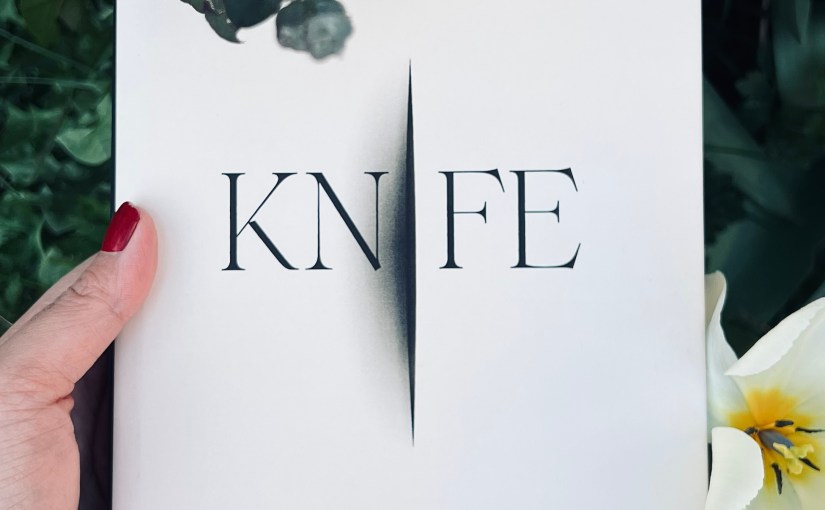
Knife, by Salman Rushdie
Meditations After an Attempted Murder
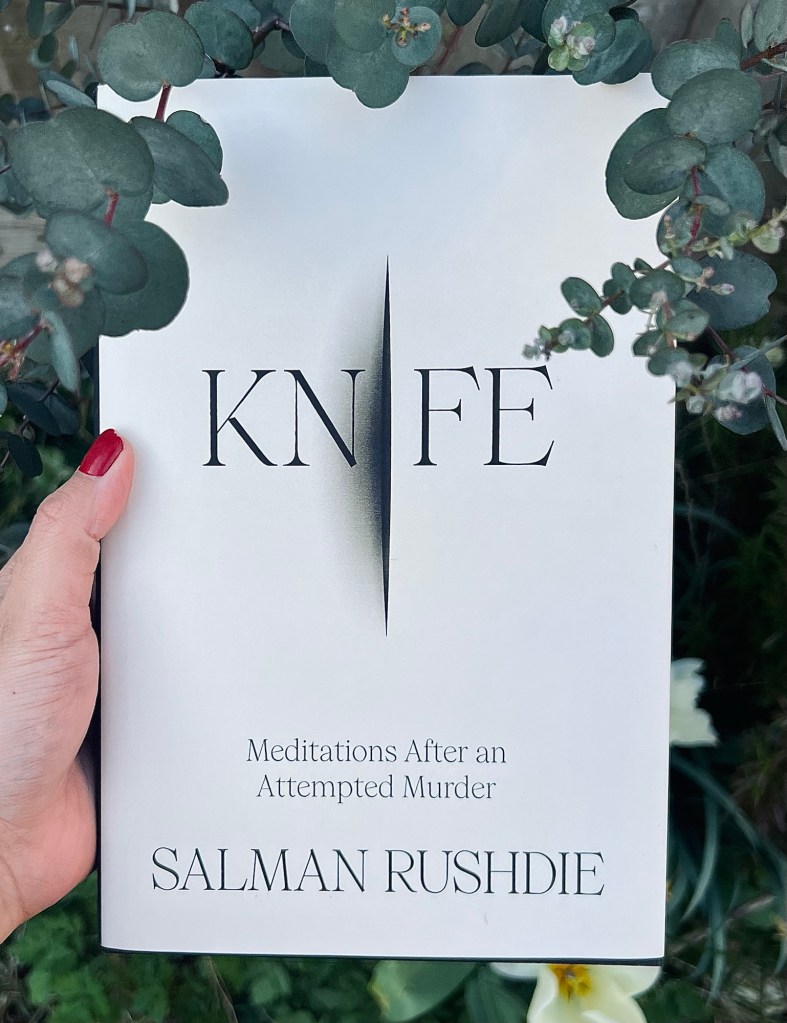
I have a deep admiration for Salman Rushdie, whose literary works combine historical fiction, religious exploration and magic realism, to take you on journeys of faith, wonder, and morality. In Knife, Rushdie attempts to make sense of the abhorrent attack on his life, taking us on his journey of contemplation, love, loss, reconstruction and healing.
Since the publication of his fourth novel, The Satanic Verses, in 1988, Rushdie has spent much of his life in hiding, or at the receiving end of death threats, for the book’s depiction of the prophet Mohammed. In 1989, a fatwa was ordered by the Supreme Leader of Iran at the time calling for the death of the author. Rushdie evaded many attempts on his life, and was even taken into police protection following an attempted assassination, but tragedy followed the book elsewhere. This review, however, is not about The Satanic Verses, and the unfortunate series of events that followed its publishing, and thus I will dwell on it no longer; but if you don’t know about the life of Salman Rushdie, it is an important foundation in understanding the context of Knife.
In 2022 Rushdie was in attendance at the Chautauqua Institution in New York, where he was preparing to give a lecture on the importance of keeping writers safe; Rushdie acknowledges the deep seated irony between the subject of the lecture, and the events that were to unfold that day. Rushdie had just stepped out onto the stage, ready to discuss the merits of the City of Asylum Pittsburgh project, which offers refuge to literary creators whose safety may be at risk in their own countries, when a man ran towards him. Dressed in black, with a mask to cover his face, the man pulled a knife and attacked. Rushdie outlines early on in Knife that he does not not want to use the name of the assassin in the account, and so out of respect, I will do the same here. After all, the account, and this review, are not about this cowardly assassin, who was too young to have been alive when the fatwa was issued, and by his own admission had not even read the book that inspired so much vitriol against the author. This review is a testament to the strength and determination that Rushdie has shown in the time since.
It is clear from Rushdie’s account that his life was on a knife-edge that day. Once recovered, the doctors told him bleakly that when he had arrived by helicopter with 15 stab wounds, they had been uncertain whether his life could be saved. But through the dedicated skills of the doctors and nurses of UPMC Hamot, and by Rushdie’s own sheer will, he survived; and twelve weeks later returned home to New York. Rushdie’s account of the attack is bluntly human, grisly, but of course in Rushdie’s way, tinged with a sense of humour that we humans require after a great tragedy. I smiled a little when he spoke of the delirium he went into immediately after the attack, where a principle concern was that those attending him would have to cut his nice Ralph Lauren suit.
The age old question of ‘what what I do if it were me?’ does dance at the edge of your subconscious when reading of Rushdie’s actions during the attack. It is a question he himself asks “why didn’t I act?’, and a question he does not have an answer for, “some days I’m embarrassed, even ashamed…other days I tell myself not to be stupid, what do I imagine I could have done?” Of course in any situation like this social media is littered with echoes of ‘I would have done this”, “I would have done that”. I firmly believe none of us know how we would act in such a situation until it occurs. We all like to think we would fight back, or find a burst of adrenaline and run faster than we have ever done in our lives, but I think we are far more likely to be paralysed by indecision and fear. Violence out of context is abhorrent to modern morality. Schools, places of worship, shops, nightclubs, theatres, these are sanctuaries, places of pleasure that should be untouchable by bullet or blade. So, when something happens that blows our morality to pieces, we falter. This was evident in the shock waves that went round the world in the wake of the attack. While Rushdie’s account is a dark narrative on the worst humanity has to offer, it also presents the best humanity has. The love we have in our family and friends, those who will be with us in our darkest days.
If my admiration for Rushdie wasn’t already at its peak, then it most certainly is after reading Knife. It is ferociously honest, deeply moving, and a testament to survival. Rushdie is at his best, with his ability to make you weep, laugh, and examine your faith in just a few paragraphs.
Book Review – Sweet Tooth, by Ian McEwan
Sweet Tooth takes place in 1970’s England, where Serena Frome is recruited for a position at MI5, as a typist. Promptly, Serena is chosen to take part in a new covert programme, Sweet Tooth, that aims to counter Communist propaganda that has seen a surge during the Cold War. Serena, a lover of fiction, is given the mission of befriending and vetting a fledgling writer at the University of Sussex, Thomas Hayley. We watch as Serena’s world begins to unravel, as her past catches up with her, and her future turns ever more murky.
Sweet Tooth is set in the backdrop of a turbulent political landscape, the Cold War, industrial strikes, ‘the winter of dicontenment’, escalation in Northern Ireland and rising support for communism, were the palpable themes throughout the 1970’s. Exasperated by a government clinging to remnants of post war ideals, the citizens of Britain became disillusioned with the electorate and in 1970 the Conservatives succeeded in bringing in a motion of no confidence against the incumbent Labour government. A 5.2% swing from Labour to Conservative was a stark reflection of the grievances felt against a government who had ‘allowed’ Britain to shrink into misery.
The story, although entirely fictional, is inspired by a scandal that shrouded the conservative literary magazine, Encounter, when in 1967 it was revealed to have received covert funding from the CIA; no doubt in order to steer the content of the magazine in an anti-communist direction. This backstory provides the perfect medium in which to explore the relationship between layperson and government, between artist and state, and it is a stark reminder of the need for literature to remain independent and free from influence (outside the natural influence of the writer that is). A quote by McEwan reflects that the aim itself, to counter communist propaganda, was not the issue, but it was the secretive, underhand, way in which it was done that caused such scandal.
“All that’s really required is that anything the state does in relation to the arts is laid on the table where we can see it.”
Sweet Tooth is a longer novel and it does seem to crawl along at times, but it is a comforting and intelligent read. Romance, spies; relationships, jobs, McEwan once again makes art out of the mundane, ‘normal’, life. This is not an action packed James Bond, in fact it is probably a far more realistic account of what work goes on within our Intelligence communities, but it is thought-provoking. As much of McEwan’s work, it is centred on a compelling moral dilemma and explores the depth of human complexity when faced with such dilemmas. I will admit it is not my favourite of McEwan’s work, but not every novel need be as thrilling as The Cement Garden or as serious as Enduring Love. Sweet Tooth is an enjoyable read, perfect to take at a slow pace.
I hope you have enjoyed this week’s reading, I would love to hear what you have read this week.
Happy Reading!
 Happy Lifestyle Happy Living