16th March 2025
Welcome to a new series where each Sunday I write about the books, articles, or other literature I have read in the week prior. Having struggled with writer’s block for the past year or two, I am diving head first back into the creative pursuits that bring me joy and inspiration. I (or the tag team of anxiety and depression) have starved my creativity with work and inane social media consumption, and whilst I must continue with work, I have ruthlessly curtailed the latter. So, now is the time when I must turn the lens inward and nurture myself with the hobbies I have been depriving myself of. Forever one of life’s great mysteries is why we consume content or partake in platforms that drive the dark storms in our minds, rather than taking the time to engage in healthy, positive activities. Of course, we know it comes back to dopamine, the old chestnut of immediate gratification and long-term loss, and I must admit I do still enjoy the occasional capybara video. I digress, please enjoy the summary of my week’s reading…
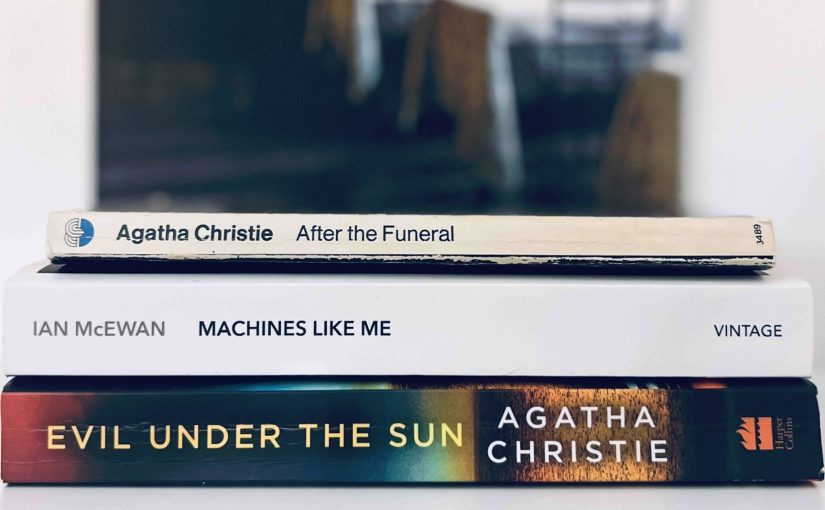
This series is partly coming about because this Christmas just gone I set a rule to our family that I was not allowed any more books until I had started to make my way through the many I had purchased that year. To my dismay everyone obeyed the rule. There are still many books I wish to purchase, and so I have decided to abide by my own rule and make my way through my bookshelves. This week I have consumed After the Funeral and Evil Under the Sun by Agatha Christie, and Machines Like Me, by Ian McEwan.
After the Funeral, by Agatha Christie
Part of the combined joy and frustration of reading Christie is knowing that she will lead you down a veined road of motivations, intuitions and evidence, only to best you every time with a beautifully placed twist. Knowing there is a twist coming never seems to take away the magic from Christie’s books, and that is part of her genius. After the Funeral is no different, a complex amalgamation of family feuds and vain ambitions, and at the end a delightfully unexpected flourish when the murderer is revealed. Initially I found it one of the least gripping of Christie’s novels I have read thus far, I think in part to the late appearance of Monsieur Hercule Poirot, who joins a few chapters in. It was nonetheless an enjoyable and easy read. The plot is engaging, once you get the hang of who is who in the Abernethie family, admittedly I had to refer back to the family tree at the beginning of the book a number of times to discern whether we were reading about a brother, nephew, widowed sister-in-law or other relative. A few times I was sure I knew who the killer was, and a few times I was wrong. Although I found the book a little slower than some of her other novels, the ending was one of the best. I highly recommend this book, an enjoyable and comforting read.
Evil Under the Sun, by Agatha Christie
Following After the Funeral I was on a bit of a Christie kick and had recently bought a beautiful old copy of Evil Under the Sun, I discovered halfway through the novel I had actually already bought a copy of the book a couple of years ago, and you will now start to understand why I laid down the ‘no new books’ rule.
Evil Under the Sun is one of my favourite Christie books so far. I felt some compassion for Poirot, who, even on holiday, finds himself in the throws of an investigation. When an expected murder (the reader gets a small win early on when the person we expect to be murdered actually is) mildly startles the holidaymakers at the Jolly Roger hotel, we follow Poirot and Inspector Colgate as they attempt to unravel the motivations of the murderer. Jealousy, affairs, witchcraft, and drug smuggling, there are no shortage of suspects…except they all seemingly have alibis. It is a gripping novel that kept me up late as I desperately wanted to know who had killed the beautiful man-magnet, Arlena. Once again Christie has woven the threads delicately to a conclusion that makes you skip back through the pages to see if you could’ve guessed right with a little more time. It was a thoroughly enjoyable read that anyone who likes crime and Christie will find captivating.
Machines Like Me, by Ian McEwan
Having reliably been bested twice in a row by Agatha, I decided to divert to a different genre. McEwan has written some of the most enthralling and chilling books I have read, Comfort of Strangers and The Cement Garden being two titles worthy of their own reviews. I settled on Machines Like Me, one of McEwans more recent titles published in 2019, and based in a dystopian alternative 1982 where Britain had lost the Falklands War, JFK had evaded his assassination, and Alan Turing was alive and pioneering research into Artificial Intelligence. I chose an interesting time to read this novel, with the sharp upsurge in AI hitting the media in recent months, it felt like a stark reminder of the complications that come with entangling our lives so profoundly in technology.
The scene is set with a young man, Charlie, living in London, and his purchase of an Artificial Life-form, Adam, his love interest, Miranda, and his precarious means of survival by playing the stock market. McEwan continues his ability to make the mundane complex, recognising that human beings, with all their idiosyncrasies, are rarely simple. We follow Charlie and Miranda as they fall in love and navigate ownership of one of 24 flagship Artificial Life-forms. The book is as much an exploration into human impulses and complexities as it is into our advancement of Artificial Intelligence. McEwan expertly shows how little we understand ourselves, our motivations that are so based on the moment, on experience, and on intuition, rather than logic. Two worlds collide in Machines Like Me, impulsive, unpredictable, humanity, and logical, considered, computers. Some make the assertion that we are no different from computers because our brains work in a similar fashion, the brain uses chemicals to transmit information, a computer uses electricity to do the same. There is no denying we are machines, in a sense, bio-mechnical in nature, however, this doesn’t account for the fact that we still understand so little about how our brains truly work, and recreating something you don’t understand is something Science Fiction has warned us fervently against. This is why Machines Like Me is such a fantastic read, the overarching story is a little “everyday mundane”, but deeper it is an analysis of what can happen when the world moves forward too quickly. As we advance forward technologically, at a pace unprecedented throughout human history, literature like McEwan’s remind us we still have a long way to go and we will make mistakes along the way.
Machines Like Me is not stomach churningly page-turning, but it is fascinating and it will leave you rolling over the progress of humanity in your mind. Reading it against the backdrop of the current world stage, it will ignite in you a debate on the moralities, practicalities, complexities and philosophies of our drive to advance Artificial Intelligence.
I hope you have enjoyed this weeks reads, and I look forward to sharing more with you next week.
Happy Living!
 Happy Lifestyle Happy Living